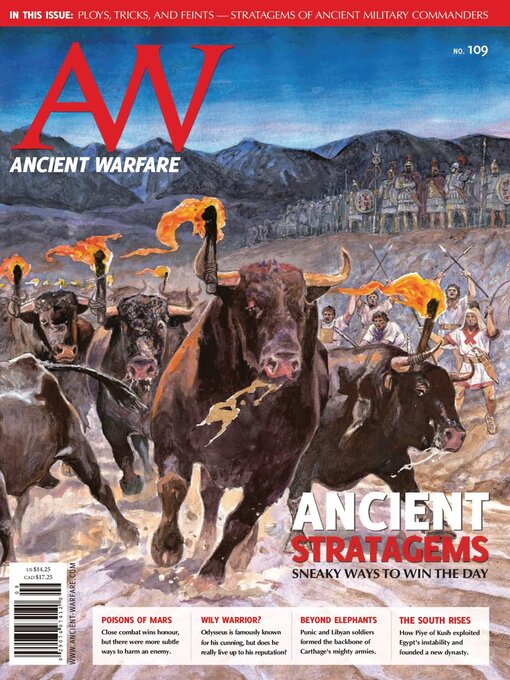
 AW 109
 AW 108
 AW 107
 AW 106
 AW XVIII.5
 AW XVIII.4
 AW XVIII.3
 AW XVIII.2
 AW XVIII.1
 AW XVII.6
 AW XVII.5
 AW XVII.4
 AW XVII.3
 AW XVII.2
 AW XVII.1
 AW XVI.6
 AW XVI.5
 AW XVI.4
 AW XVI.3
 AW XVI.2
 AW XVI.1
Ancient Warfare is a unique publication focused exclusively on soldiers, battles, and tactics, all before 600 AD. Starting with ancient Egypt and Persia and continuing to the fall of the Western Roman Empire, Ancient Warfare examines the military history of cultures throughout Europe, the Middle East and parts of Asia and Africa. Ancient Greece and Rome receive the most frequent coverage, due both to the wealth of contemporary sources and the modern fascination with these two great civilizations. Subject-matter ranges from the familiar to the more obscure: while Alexander the Great, the Persian Wars and Caesar’s Gallic campaigns all receive regular coverage, Ancient Warfare also looks at some of the less common parts of ancient military history, from chariots as battle taxis to PTSD in antiquity.
Ancient Warfare Magazine
PRELIMINARIES • THE LATEST NEWS AND DISCOVERIES IN THE FIELD OF ANCIENT MILITARY HISTORY
EDITORIAL - Tricks of the trade
Inside an Egyptian border fortress
Melting ice exposes prehistoric arrows
Enough iron to forge 500 swords
Roman legionary tools found in Perperikon
Roman settlement discovered at Kapersburg fort
Weapons of an elite Bronze Age Warrior
HAVE YOU READ? • The War Cry in the Graeco-Roman World
Detectorist discovers hoard of denarii
THE ‘ALCHMONA REDIVIVA’ • Supplying military fortresses and their civilian settlements near the border was a top priority for Roman provincial administrators along the so-called wet and overland limes. A good supply of military equipment and provisions guaranteed the combat readiness (and loyalty) of the soldiers far from home. It was not without reason that Roman conquest was usually followed by the establishment of a network of long-established and proven methods of Romanisation: baths, amphitheatres, roads. However, the most effective supply was by water, along the rivers on the border or crossing the border.
VASA SILENTIO COLLIGERE • Twice during the Second Punic War the Romans faced the prospect of a Carthaginian army being led across the Alps to invade Italy, once by Hannibal in 218 BC and then by his brother Hasdrubal in 207 BC. In each case an army was dispatched to block their advance. Yet, in the accounts provided by our primary source, Livy, the first battle of each incursion was preceded by an encounter which resulted in one side or another having to beat a surreptitious retreat under cover of night. Livy reports the order given each time as vasa silentio colligere, which might be translated as “to collect one's gear silently”.
PICENE HELMETS • Helmets are among the most recognisable accoutrements of the ancient warrior, and they survive both in relatively large numbers and in great variety. Every culture attempted to combine the requirements of protection and the limitations of materials and crafting abilities with the need to project a warrior-like image and invoke divine assistance. In this series we'll take a look at some of the different solutions found to solve the same problem: how to protect one's head while looking good?
THE SOURCE OF CARTHAGE'S POWER • Carthaginian armies in the 2nd Punic war famously included thousands of foreign mercenaries and allies. Yet the Punic and Liby-Phoenician troops of Carthage, despite being labelled as some of their best troops, receive little attention. Although the literary and archaeological evidence is scattered, we can still form a proper image of what the African troops of Carthage looked like.
WHAT EXACTLY IS A STRATAGEM? • From Odysseus in the Trojan War to today, history is replete with commanders, officers, and even common soldiers who have used some trick or other to gain the upper hand in battle — in other words, a stratagem. Indeed, there has probably never been a time when such wiles did not play at least some part in...